
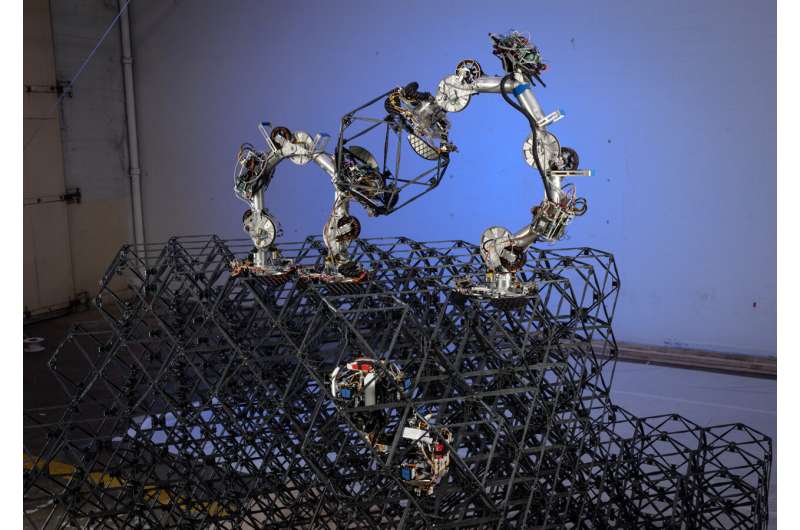
A joint team of engineers from NASA Ames Research Center and KBR designed and built a robotic system that can autonomously build structures using specially designed truss blocks. In their paper published in the journal Science Robotics, the group describes the robots, the mesh blocks they use to build the structures, and how the entire system works.
Read also: This camera takes 1000 years to take a single picture
As NASA and others consider the possibility of sending humans to the Moon and perhaps other planets, they must also consider the means by which they will be protected. Ideally, robots could be sent to desired destinations before humans arrive to build such structures. In this new study, the research team developed a type of robotic system capable of autonomously building the desired structures.
The system consists of three robots, two of which move the mesh blocks and the other connects them. The mesh blocks are hollow, with edges that resemble coat hanger wire. The three robots can grab any block – two robots pick up the blocks from a certain location and take them to the construction site. In addition to picking up, carrying, and placing blocks, transportation robots can deliver blocks to each other.
The third robot is placed inside the structure as it grows, allowing it to connect blocks placed by the transport robots. The blocks are connected using swivel connectors similar to those used to connect IKEA furniture. The three robots work together, like ants in a colony, to build a structure designed by researchers — or perhaps future astronauts.
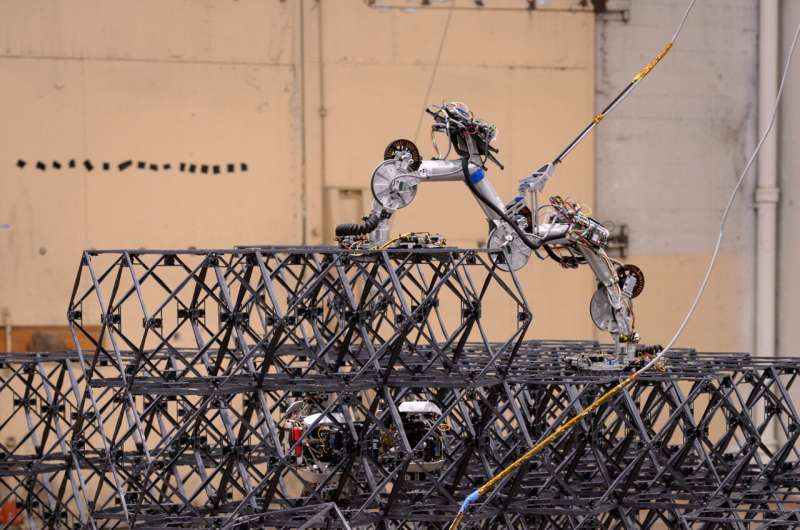
Credit: NASA
The research team actually tested the system by having it build several structures — in one example, they built a 256-piece shelter, a feat that took the system 4.2 days straight. They suggest that a system similar to theirs could be sent to the Moon or beyond to build structures, towers, or other facilities before the astronauts arrive. In their current design, the astronauts would have to put some sort of covering on the outer blocks, but that would likely be automated as well.
Article published in TechXplore
More information: Christine E. Gregg et al., Light, Robust, and Self-Reprogrammable Mechanical Materials, Science Robotics (2024) doi: 10.1126/scirobotics.adi2746

Chris Skeldon is a contributor to Brytfmonline.com, covering a wide range of topics including news, politics, business, technology, sports, entertainment, and lifestyle. He focuses on delivering clear, accurate, and reader-friendly reporting that helps audiences stay informed about current events and emerging developments. With an emphasis on useful information and balanced storytelling, Chris aims to provide timely coverage of issues and stories that matter most to readers.