
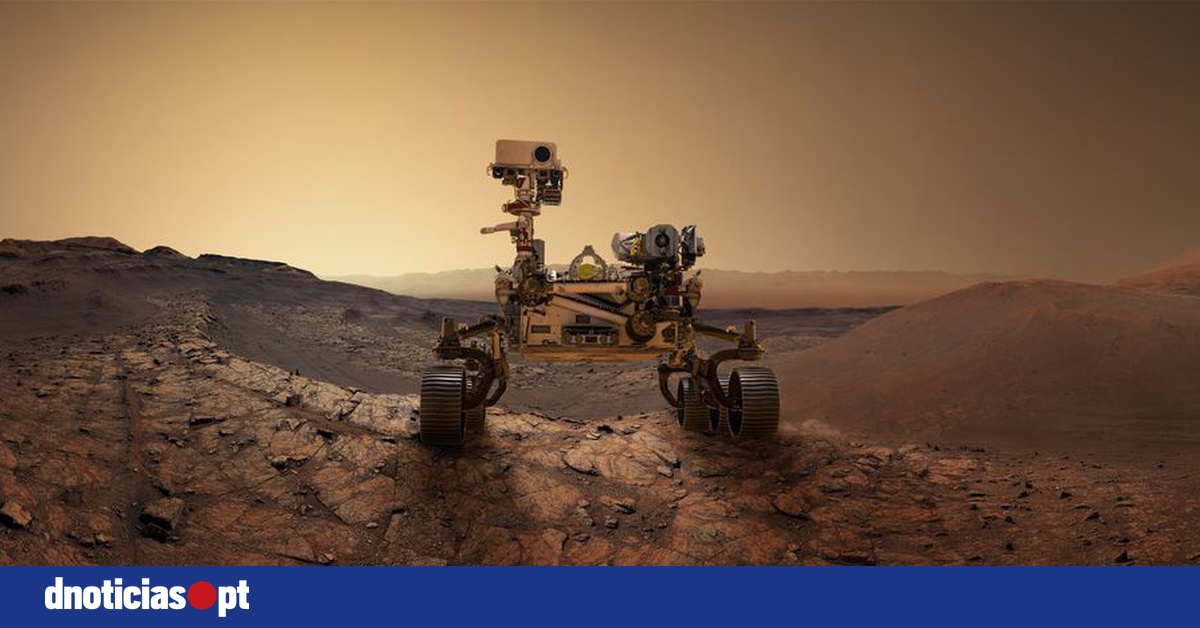
The North American robot “Perseverance,” which arrived on Mars about three years ago, confirmed that Jezero Crater, where it landed, previously contained a lake, as was announced today.
The car-sized device landed on Mars on February 18, 2021, as part of a mission led by the US Space Agency (NASA) aimed at searching for (biochemical) signs of previous microbial life on the planet.
This mission is scheduled to be completed in the 2030s with another mission, in partnership with the European Space Agency (ESA), by sending unprecedented samples of Martian rocks, soil, and dust to Earth for study.
The choice of the landing site for the “Perseverance” robot, which is equipped with several scientific instruments, was not a coincidence, as scientists have always acknowledged the existence of a lake, a source of liquid water, in the Jezero crater 3.5 billion years ago. An essential element of life as we know it.
A new investigation published today in the scientific journal Science Advances, based on data collected by NASA's robot, concludes that Jezero Crater was, at one point, a lake, with layers of sediment at the bottom.
The lake then shrank and the sediments carried by the river that fed it formed a huge delta (an alluvial plain located in the terminal part of the river and resulting from the accumulation of sediments).
As the lake disappeared over time, the sediments eroded to form the geological features that appear on the surface today, the University of North America in California, which participated in the study, says in a statement.
According to subsurface information collected by the Perseverance radar, periods of sediment deposition and erosion occurred over eons of environmental change, which confirms the accuracy of the conclusions reached by scientists about the geological history of Jezero Crater, based on images obtained from Mars to space.
Radar images also revealed that the sediments are regular and horizontal, similar to sediments deposited in lakes on Earth.
Despite being inhospitable, Mars is considered the most Earth-like planet in the solar system. Geological structures show that, long ago, liquid water was abundant on the surface of the Red Planet.
According to scientists, the planet once had an ocean larger than the North Pole.
Studies, based on observations made in orbit and on the surface, have previously indicated the presence of salty and icy liquid water on Mars.

Chris Skeldon is a contributor to Brytfmonline.com, covering a wide range of topics including news, politics, business, technology, sports, entertainment, and lifestyle. He focuses on delivering clear, accurate, and reader-friendly reporting that helps audiences stay informed about current events and emerging developments. With an emphasis on useful information and balanced storytelling, Chris aims to provide timely coverage of issues and stories that matter most to readers.