

Whether it’s alone, as a family, with kids, pets or live Instagramthese experiments are guaranteed fun (even if you have a lot to clean up after…but here we go!).
Here are the three suggestions for activities we offer you:
1 – Magic Milk
You will need:
- whole or semi-skimmed milk;
- food coloring;
- washing powder for dishwasher;
- cotton swabs;
- plate or cup.
Begin by pouring the milk into the dish, covering the entire bottom of the dish.
Then apply a few drops of food coloring (available at any supermarket) in the pattern you want. The fun starts here, you can be creative, but be careful not to shake your plate. When you are happy with the artwork, dip a cotton swab into the cleaner and bring it vertically toward the board.
Dip a cotton swab in milk without hesitation and watch!
what happened? I got rid of the colors from the cotton swab and mixed together. You can repeat the experiment several times and notice that the colors are mixed more and more often.
Why does this happen?
The detergent is loaded with amphipathic molecules, that is, molecules with a hydrophilic side (attracting water molecules) and a hydrophobic side (the opposite, being repulsed by water molecules). Milk contains water and fat, and when it comes into contact with detergents, the various molecules quickly separate, resulting in the effect revealed by the presence of a food coloring.

2 – Magic block or quicksand
You will need:
- corn starch / maizena flour;
- water;
- big cup
- Cover the surface with newspapers or trash bags.
Add ½ cup of cornstarch to the bowl. Slowly add ½ cup of water, stirring slowly, until the powder is completely wet. Keep stirring – note that when you stir the mixture behaves like a liquid.
If you stop stirring and press the mixture with your finger, what happens? The mixture is solid and withstands the pressure it is experiencing! (If mixture is too runny, add more cornstarch.)
Take a portion of the mixture and hold it in the palms of your hands until you make a ball. The ball will remain solid as long as you exert force on the batter. Once you stop touching the ball, the ball turns into a liquid and disperses through your hands.
You can also check the difference between perforating the mixture (stays solid) or picking it up slowly and gently (stays liquid).
Congratulations, you’ve made a magical dough!
Why does this happen?
Magic mass, in fact, is the so-called non-Newtonian fluid, that is, a fluid whose viscosity depends not only on temperature, but also on the force applied to it and the speed with which this is exerted. The dough you made behaves differently from honey, for example, whose viscosity depends only on the temperature at which it is present. Quicksand and ketchup are other examples of non-Newtonian fluids.
3 – volcano
You will need:
- plastic bottle
- water;
- big cup
- washing powder for dishwasher;
- food coloring;
- Sodium bicarbonate (NaHCO3);
- vinegar;
- sandbox (optional);
- Newspaper (optional).
Start by heating the water and fill the bottle about halfway.
Add 2 tablespoons of baking soda (you can find it in the pastry aisle of any supermarket), the more you add, the more it boils.
Then close the bottle and shake it until the powder dissolves in the water. Now you can decorate your own volcano!
Pour sand around the bottle until it is covered in the traditional shape of a volcano – you can use newspapers to increase the volume and facilitate the shape.
Let’s go back to the bottle and add a few drops of food coloring and ½ teaspoon of dishwashing powder.
Finally, vinegar! Pour the vinegar into the bottle until it starts to burst and watch the way the bottle rises and builds up on top of it.
Why does this happen?
The real reaction here is between baking soda and vinegar, and the rest is for decoration! This is an acid-base reaction. Sodium bicarbonate (NaHCO3) acts as a base, and vinegar (dilute acetic acid, CH3COOH) as an acid. The interaction between the two releases several substances, one of which is carbon dioxide (CO .).two) as a gas responsible for the bubble effect we observed. Try to repeat the experiment with different combinations of quantities and see what happens!
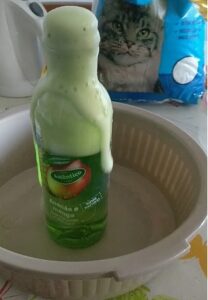
Show us the results of your experiences via social networks, mentioning JUP in your posts. Don’t miss the following suggestions for applying science at home!
–
Text by Rita Prata Magalhaes. Reviewed by Maria Theresa Martins.

Andrea Hargraves is a contributor to Brytfmonline.com, covering a broad range of topics including news, politics, business, technology, sports, entertainment, and lifestyle. She is committed to delivering clear, accurate, and reader-focused reporting that helps audiences stay informed about current events and emerging developments. Andrea’s work emphasizes useful information, balanced coverage, and stories that matter to everyday readers, making complex topics accessible and relevant to a wide audience.