
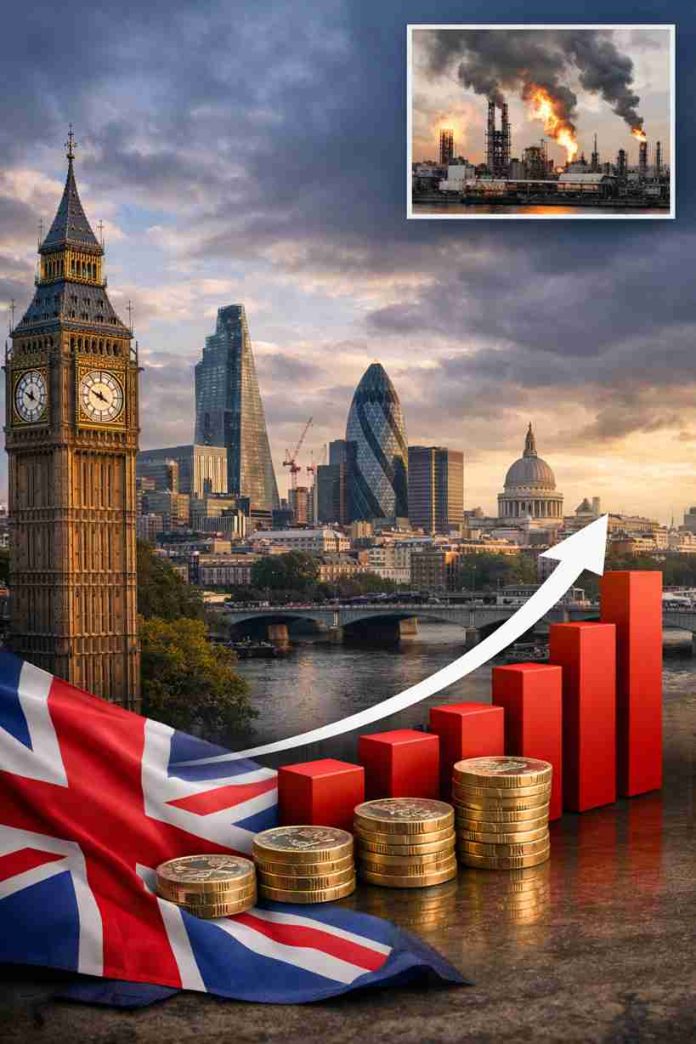
The UK economy recorded stronger-than-expected growth in early 2026, offering a short-term boost to confidence before rising geopolitical uncertainty. However, economists caution that this uptick may prove temporary as external pressures mount.
GDP Rises by 0.5% in Three Months to February
The UK economy expanded by 0.5% in the three months to February, according to the Office for National Statistics (ONS). This exceeded forecasts and marked a notable improvement after a stagnant final quarter of 2025, which was revised to show zero growth.
On a monthly basis, gross domestic product (GDP) — the primary measure of economic output — also rose by 0.5% in February alone.
Services Sector Drives Economic Expansion
Growth was largely fuelled by the services sector, which remains the backbone of the UK economy. According to ONS chief economist Grant Fitzner, strong performances were recorded across several industries.
Key areas of growth:
- Wholesale trade
- Market research
- Hospitality
- Publishing
These sectors collectively helped offset weaker performance elsewhere and underline the continued reliance on consumer-facing and knowledge-based industries across Britain.
Manufacturing Recovers but Construction Remains Weak
Industrial output also contributed to the positive figures, with overall production rising by 1.2%. A key factor was the recovery in UK car manufacturing following disruption caused by a cyberattack on Jaguar Land Rover, which had halted operations for over a month across its global network.
However, the construction sector continued to weigh on overall growth. While output declined at a slower pace than previously estimated, it still limited the broader economic expansion — reflecting ongoing challenges such as high borrowing costs and subdued housing activity.
Government Welcomes Growth Figures
The government responded positively to the data, framing it as evidence that its economic strategy is beginning to deliver results.
Chief Secretary to the Treasury James Murray said the figures showed that “growth only happens when the economy is on solid ground,” pointing to ongoing efforts to stabilise the economy, encourage investment and implement structural reforms.
He also referenced discussions at international meetings in Washington, where the Chancellor outlined plans to improve the UK’s competitiveness, reduce costs for households and businesses, and lower energy bills — including measures aimed at cutting expenses for thousands of firms.
Outlook Uncertain Amid Global Pressures
Despite the stronger-than-expected performance, analysts warn that the growth may be short-lived. The figures predate escalating global tensions, including conflict involving Iran, which could affect energy prices, trade flows and investor confidence.
With inflationary pressures still a concern and interest rates remaining relatively high by recent standards, the outlook for sustained growth remains uncertain. Businesses and households alike continue to face cost pressures, while global instability adds another layer of risk.
Conclusion
The UK’s better-than-expected GDP growth offers a welcome, if tentative, sign of resilience in early 2026. However, with domestic weaknesses and international uncertainties looming, the latest figures may represent a brief high point rather than the start of a sustained recovery.

Chris Skeldon is a contributor to Brytfmonline.com, covering a wide range of topics including news, politics, business, technology, sports, entertainment, and lifestyle. He focuses on delivering clear, accurate, and reader-friendly reporting that helps audiences stay informed about current events and emerging developments. With an emphasis on useful information and balanced storytelling, Chris aims to provide timely coverage of issues and stories that matter most to readers.